Sunday, April 10, 2016

Remember, Don't Run Unless I Tell You To Run ...

Moving right along, we're at the Okavango Delta in Botswana


Today's Geography Lesson:  This delta is unique because the Okavango River flows from the highlands of Angola, through Namibia, and into the landmass of Botswana - it does not flow into the sea.  
It empties into the flatland of northern Botswana, which eventually further south turns into the Kalahari Desert.  The river spreads out and becomes an immense area of wetlands and islands to form one of the world's largest inland deltas. 


We went there today from the small town of Maun, Botswana.  It was a fairly distant hour-and-a-half ride in an open jeep that led to an off-road adventure deep into the bush.   When we got to our first stop, we got out of the jeep and were met by some locals in small dug-out canoes. 

This is something we anticipated, because that's how you get out into the Okavango Delta, by small man-powered boats (full disclosure, the boat we were in was actually coated in fiberglass, but I don't want to ruin the vibe).   We set off in two boats, with another couple, Luke and Yana. 

These boats are "pushed" along by experienced guys called "polers" who have a long stick that they use to push off the bottom to propel the boat forward.   Frankly, the boats seemed real tipsy, and we were warned not to move suddenly or shift our weight.  It took a while to get used to them, it felt like they could tip over at any moment. 


It was a sublime adventure, as we wound our way through long patches of open water, only to find ourselves in very narrow channels of deep grasses in a labyrinth that seems impenetrable.   The weather was perfect, warm, sunny, and big billowy clouds.  


We had one rather disconcerting moment on the way out to our destination.  We came around a tight bend in a narrow channel, and the two boat pilots got excited and we came to an abrupt stop. We were in the front boat (and I was in the front seat) and the guides were very concerned that there was a hippo in front of us in the water.  

Hippos are huge beasts and can be very dangerous if provoked. We stopped and waited ... there were bubbles coming up out of the water.  We waited for the hippo to move.  The boat pilots made a bunch of noise to scare the hippo away, to no avail.  It got kinda tense.  If a hippo attacked us in these little boats in the middle of this grassy marshland, we were goners.   

We eventually quietly passed through the spot, never seeing the hippo.  They can stay underwater for ten minutes or more.  It was especially unsettling for me, because if that big dude attacked, I would be the first to go ...

Eventually we arrived at terra firma (dry land), and got out to commence our next episode - a game drive on foot.  We were going hiking.  This was a really cool way to go out and find animals - by walking around and looking for them.  

The pilot of one of the boats became our walking guide.  He gave us many instructions - one of which I will quote here: "Remember don't run unless I tell you to run, please wait until I instruct you to run, and then run fast!"

We were on an "island" and in theory there were potentially a bunch of animals.  We walked a long ways and didn't see anything, but just when we thought we would come up empty, we saw a giraffe, and then some zebras, and then two more giraffes.  And before long, we encountered a huge pod of hippos at a watering hole.  I counted somewhere near 36 of them.  Awesome! 


Keep in mind we were on foot.  We got real close to one of the giraffes.  This was one of the highlights of the trip so far.  We were within fifty feet or so. 

And one final bit of excitement - when we got back to the boats and got ready to set sail for home, there was a hippo in the water just out from the boating launch.  Not good.  We could definitely see this one, and the boat guides said we had to find another way to put the boats in. 

So we had to carry them a couple hundred yards and put in at another spot some distance away.  


Tomorrow will be a travel day, not sure if there will be much to report ...


Saturday, April 9, 2016

In The Jungle ... the Lion Sleeps Tonight ...

So We Pick Up Where We Left Off ...

I promised a lot of photos - this is a picture fest 


I was in the middle of the previous blog post when the internet died, but tonight we are in Maun, Botswana, and we have decent broadband available.  I will attempt to catch up.

So it's picture time.  The last couple days included some game drives, and some river cruises - for the purpose of finding and observing the animals of Africa.  This took place in Zambia and Botswana.  

These monkeys below were actually just outside our room at the lodge by the Chobe River.  They are active little buggers so you better not leave anything outside your room!  The big guy in the middle was about four feet tall. 


This region has a lot of water, which makes it popular with animals. In this rare shot from the River, you can see an elephant on the shore and hippos in the water.  


One of our favorite African critters is the giraffe.  They are so big and unusual, yet graceful and they move in slo-mo, which makes them rather mesmerizing.   This shot captured them with some neighbors. 


We actually got to the see - the grand prize of animal viewing, a pride of Lions!  
Often you can spend a lot of time looking for lions without results.   They are not fond of cameras or people, so it's hard to get a good shot. This is the best I could do.  
The first picture shows a large male, with a big dark mane.  The second shows two females.  They were hunting and we just missed a shot of them in a high speed chase of a warthog!


Of course, this being by the river, there are numerous warning signs to beware of Crocodiles.  We saw several and fortunately they were not super close.  This one is relaxing on the bank of the river.


There are a number of large, and small, animals such as Kudu, Gazelles, Springboks, and such, and they tend to run in herds.  This Kudu was big, as big as a horse, and had some seriously twisting horns.   And there were Impalas everywhere, like the one in the second picture below, with a warthog in the background. 


So we talked about the graceful and elegant giraffe - except when they're drinking water.  They are so tall that the water is a long way down and they have to do the splits to spread their legs enough to reach the water.  It's pretty funny, especially from behind.


And you get some amusing views during the day, like this shot of the elephant on shore and the boat in the water.  I thought about making this a caption contest, you know, where you supply a humorous caption for this photo ... but ... 


Speaking of hippos, we got a picture of this bad boy in the marsh near the Chobe River.  These guys can weigh up to 3,500 lbs and they can run faster than you think. 


And anyone who follows this blog will not be surprised by yet another sunset photo, but this one has a twist.  We are at the conjunction of four countries - Zambia, Botswana, Zimbabwe, and Namibia.  
So this photo was taken from the Botswana side, as the sun set over Namibia.  Our boat guide explained to us that "the sunset belongs to Namibia, but the view and reflection? They're ours!"


So this is not exactly a selfie, but an elephant came into our tent camp this morning and friends of ours captured this moment - with us waving in the background from the porch of our tent. 


More to follow soon.  Tomorrow we go to the Okavango Delta for a dugout canoe trip and some hiking. 

Thursday, April 7, 2016

Up Close and Personal with African Beasts

Today was the day for animals 


Now that we have arrived in Botswana, we jumped right into the safari thing, with a morning tour that left before dark, and an evening tour that finished at sunset.


In the course of the day, we saw a wide range of African animals, hitting all the high points with elephants, zebras, giraffes, water buffaloes, hippos, monkeys, baboons, gazelles, springboks, reeboks, warthogs, innumerable exotic birds, eagles, cranes, and a whole lot more!

Without going into too much explanation, I thought I would let the pictures speak for themselves.  One minor regret is that we had Danae with us for the first part of this trip in Senegal, and she has since returned home - but she would be in heaven here with her camera and professional photography skills in the wilds of Africa. 

Instead I am stuck with my old standby iPhone camera, which takes decent pictures, but is woefully inadequate in an Africa game reserve.  And I don't want to make this day sound ordinary.  However, I have been accused of over-using the word "spectacular" - but that's exactly what the day was ...

---------------------------------------------
(One hour later) 
---------------------------------------------

Well .... on second thought ... the internet has crashed here at this remote location in Botswana, so I will have to let the pictures speak for themselves another day.  

One of the challenges in doing this blog at distant locations around the world is that broadband internet is not a fundamental human right - it is a privilege, and we take it for granted until we don't have it available. 

Which is where we find ourselves tonight ... 


Wednesday, April 6, 2016

Waiting for Our Ship to Come In - an Essay


Can Anyone Tell Us What's Going On?


The last twenty four hours have been pretty eventful, as we made our way from Livingstone, Zambia, to Chobe, Botswana.  However, it was not exactly a smooth transistion.  Even the best laid plans can be thrown off the tracks, as we found out today.

We set out after a leisurely morning at the Hotel.  We slept in today, since the time change and travel have left us a bit tired.  We’ve been on the go constantly since Sunday in Senegal, and you learn to catch up on sleep when you can.  Anyway, the driver showed up mid-morning.  He was not the same guy we were told would pick us up ... a possible sign of concern.  

After working and “being on the clock” in the villages of Senegal, we have now entered the travel adventure phase of this trip.  We like going to places we’ve never been, so here we are in Zambia, Botswana, and Zimbabwe.  There are many spectacular sights to see in this neck of the woods.  

So we set off with this new driver who was going to take us across the border.  Just which border was not entirely clear.  I had understood we were going to Zimbabwe, but no, we were heading one hour’s drive to Botswana.  Africans are able to endure a huge amount of ambiguity.  Their lives are filled with ambiguity. Often, no one seems to know what’s going on, at least it seems that way to us.

Anyway, the vehicle is a nice rig and we drive cross country to our uncertain destination.  The weather is nice, warm and sunny, and it’s a very pleasant drive through the rolling hills of Zambia.  We come to a remote intersection on the road and turn, and by this time it has become clear that the border is a river.  What river, we’re not quite sure, we understand that the Zambezi River meets the Chobe River at the place where we were supposed to cross.


The first thing we notice is a super long line of trucks, waiting to cross the river/border.  We’re talking hundreds of trucks, a line maybe two miles long.  Our driver explains that they have to wait to cross the border/river and sometimes it can take up to two weeks!  What, are you kidding me?  It takes two weeks to get across this river?  No, he says, cars can cross quicker.  

So we get up to the front of the line, and it’s like a frontier border/river crossing.  Hundreds and hundreds of people milling about, countless trucks, border guards with big Automatic Rifles, vendors selling bananas and trinkets, with an atmosphere of general choas and confusion.  We wait for a while ... and realize there is no one there to meet us.  

The idea is that this driver will hand us off to another driver who will take us across the river to Botswana.  We are very unfamiliar with this plan.  We wait and nothing happens.  Our replacement driver tries to find someone or call someone, and gets no response.  He wanders off for long periods of time and we sit there in strange surroundings.  We wait and finally go through customs and enter the large amazing loading zone area on the riverbank - amazing because of the anarchy going on.  

There is still no one to meet us and the driver can take us no farther.  We’re starting to become annoyed at all this “ambiguity”, and frankly, we have no idea what the hell is going on.  People try to help us but have no idea either, and the vendors try to sell us food, and little carved elephants.  “I make you good deal my friend!”

So this goes on for a couple hours.  Why haven’t the guys who are supposed to meet us contacted us?  We can see the other side of the river/border and there are a bunch of trucks over there waiting to cross to our side.  We find out that at this point in Africa, four countries actually converge - Zambia, Namibia, Botswana, and Zimbabwe.  

Finally the original driver we were supposed to have ... shows up.  The new driver and him get into a heated discussion, but we still don’t know much.  How do we move on from here?  Eventually they assure us that the guys from the other side are coming to meet us.  Yeah, right ....


But about twenty minutes later, the small rickety ferry boat (which can only carry basically one truck at a time) shows up and there is our guide "Blessing" - that’s right, his name is Blessing.  I had some thoughts about a name like that after the chaotic day we had so far, but we traipsed on foot with our bags and hopped across the gap onto the boat, (which is probably smaller than the Buena Vista Ferry across the Willamette in Oregon), and we make it to the other side, Botswana.   

As I sit writing this blog post in Kasane, Botswana, on the shores of the Chobe River, I reflect.  Patience has never been a strong point of mine.  You have to be able to adsorb a high degree of amibguity in Africa, and we had our fill today.  Hopefully, things begin to improve tomorrow, and looking back, a day like this can seem amusing.  But not while you’re going through it.  At least I was able to get some decent pictures.

------------------------------------------------------

So we get to our hotel in Botswana and are greeted by signs warning us about Crocodiles. Apparently they are all around and occasionally eat people. I will keep my eye out.


And outside our room, there was a bunch of these critters eating on the lawn. Warthogs are not pretty animals, somebody at dinner told us they are part of the Big Five of ugly animals.
I was trying to get close to get a good picture and this dude charged me! Yikes! I tried to calm him down "easy now, easy fella, just want to get a photo ... smile!"


Tuesday, April 5, 2016

Zambia! Sunset! Currency Exchange! What?

I'm a sucker for a good sunset photo ... or two ... or three


We arrived in Zambia today.  
Okay ... How did we get here?  And where is Zambia?  We left Dakar Senegal early, early, Monday morning (Sunday night?), and flew to Johannesburg, South Africa.  

We spent last night in "Jo-burg" as they call it, and then left this Tuesday morning to fly to Livingstone, Zambia, the home of Victoria Falls, one of the most spectacular waterfalls in the world. 

Unfortunately, since we arrived this afternoon, there wasn't time to see it today and we leave for some other areas tomorrow, so we won't see it for a couple days yet.  (trust me, it will be there when we come back!)


But we did go on a sunset cruise on the Zambesi River, as shown on the sunset pictures displayed on this blogpost.  The Zambesi is one of Africa's great rivers, and eventually tumbles over the Falls downstream from where we are.

Zambia is located in South/Central Africa, next to Zimbabwe and Botswana, both of which we will visit in the next few days.  

On the boat trip tonight, we saw Hippos, and Crocodiles, and Baboons, and a bunch of cool African birds - such as an Open Bill Stork - how's that for a trivia question?

Anyway, we watched the sun go down while enjoying a Gin & Tonic on the boat, a very sublime experience. 


Okay, so how do we pay for all this travel?

Well, it doesn't cost as much as you think.   Admittedly, I don't know how much you think it cost, but it is surprisingly affordable. 

In fact, I wanted to explain a key factor in the cost of travel and how it gets paid for.  We pay for most things using American Dollars, which at the current time is at an all-time high.  The dollar has risen against almost all world currencies, so that means travel is on sale!

Let me expand on that.  First of all, despite what several politicos might say, the US economy is in pretty good condition, maybe even very good.  In fact, it is the envy of the rest of the world.  Without getting too technical, that means the value of other currencies goes down in comparison to the dollar. 

So when we order a steak and nice meal in South Africa, it can cost like $3.50 - and I'm not making this up, we had dinner there last night.  Almost everything else is way less expensive too - hotel rooms, taxi rides, bus tickets, clothing, travel excursions, etc. 

Across the board, everything costs less.  Now, I don't want to pretend that you travel the world to save money, but if you want to go to other countries, now is a very good time, financially.   Granted, Fiona and I have enough resources to travel, and we place a high priority on visiting unusual places.  

Let me give a final example:  We have come all the way to Senegal to do the good work of Andando in helping people - and once you're here, you can fly to Zambia for like $300 - why not do it?

All in all, most people might be surprised to find out how far they can go on a little money.    


Sunday, April 3, 2016

Moving from One Phase to Another - Notes on the trip so far

We are finishing up our time in Senegal ...

The time here has gone quickly, and we are at the Airport Hotel waiting to fly out in the morning to our next destination.   I wanted to have a look back at some of the events of the last few days. 


Goree Island 


One of the top sights to see in Dakar is a boat trip to Goree Island, just off the coast from the center of the city.  It's a cool place to visit with a lot of history from the early colonial days, when Senegal was ruled by the Portuguese, Dutch, and French.  It is where a lot of slaves were shipped to the New World between 1600 and 1800. 

Visiting this place always has an emotional impact.


The Rose Colored Lake 

We also did a lot of walking on the beach in Dakar, and at one point went to visit Lac Rose (or Pink Lake in French).  There was a nice restaurant there where we had lunch and we then set out to walk back to where we were staying - no small feat, as it was around ten miles.


We walked all the way home on the beach.  It was fun but walking in soft sand for three hours kinda takes its toll.


Wall hanging Senegal style 

As a follow up to the earlier story about our search for a long stick to hang some wall art, this is what it looked like once we got back to our base house in the village of Keur Soce.   It's pretty funky, but it works.  We ran out of time to do a better job of decoration.  Next time we'll take off the feather duster part on the left.


Handing out pictures to someone who has never had one ... 


As a professional photographer, Danae was a key part of this trip. She not only took innumerable photos of the people and places, but she also printed them.  She had a small but fairly sophisticated printer than ran on a battery pack, so we could print in the village. 

Below shows some of the people when they were given their pictures. 


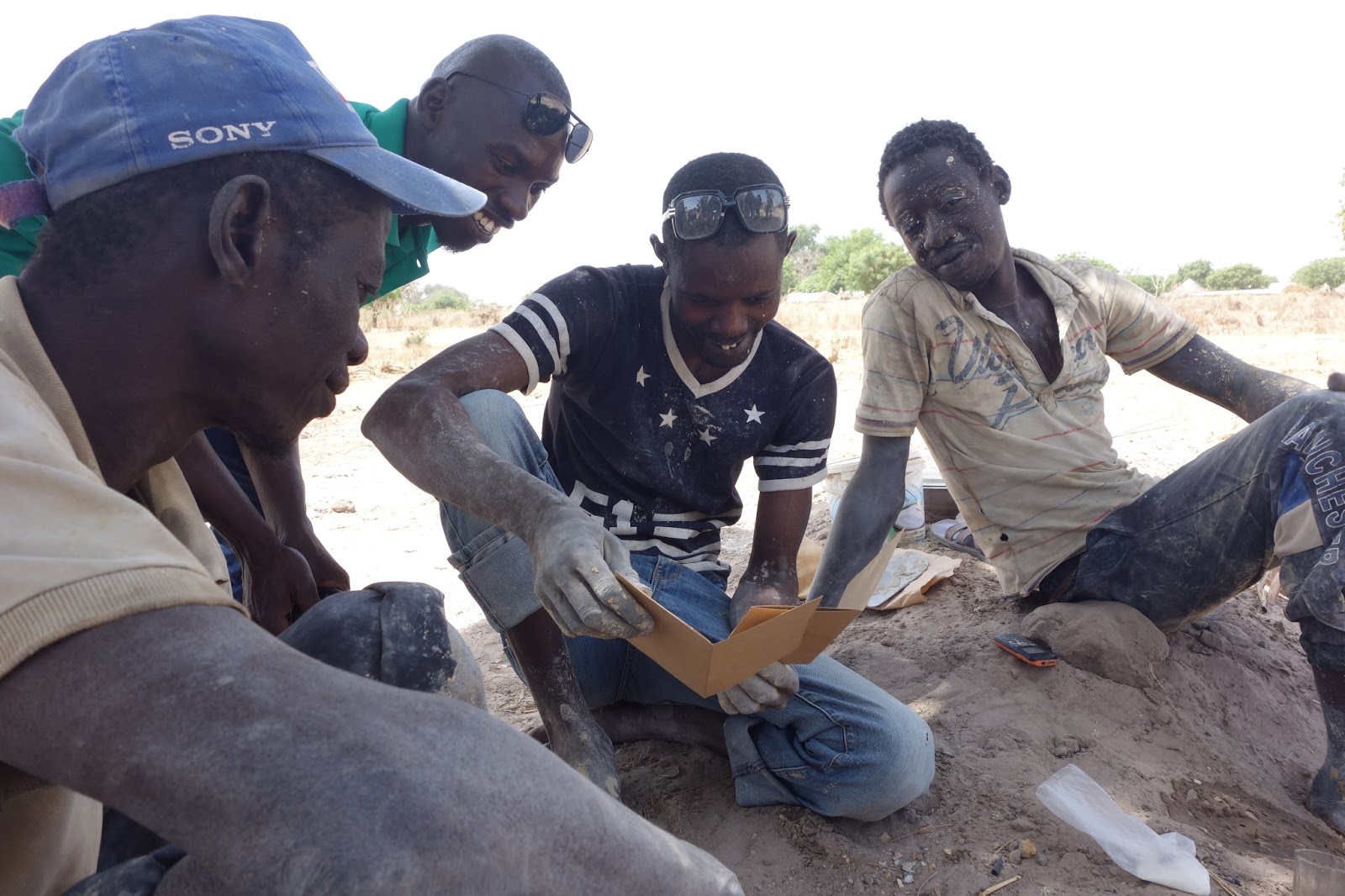
These are the well diggers in Sama Toucouleur


This local lady is Nene Sy, the midwife at the health post we are building in the village.  Senegalese people typically don't smile when their picture is taken ... 


Danae with pictures of the kids in the Garden.

----------------------------------------------

Speaking of Gardens, we have just undertaken a major expansion of our Market Garden program in the village area.  These are solar powered pump systems that provide water year round to parched regions.  This allows almost anything to grow in that sunny climate. 

A Market Garden is where the local ladies can grow not only enough hearty and nutritious vegetables to feed their families, but also have enough produce left over to sell.  


----------------------------------------------------------

Danae is on her way home, but our next stop is place much further south from here.  Fiona and I will spend ten days in the southern part of Africa. 

Friday, April 1, 2016

Winner, Winner, Chicken Dinner - one in every pot?

We were quite pleased to see the progress of a new project in Senegal

In the pursuit of helping develop resources for our friends in the Keur Soce area of Senegal, West Africa, we like to bring new things to the table. 

This year we have already started several new building projects.  We are delighted with the growth in many areas.  Specifically, a new Health Post is well underway in Sama Toucouleur, and according to our surveys, this health post will eventually serve a population of up to 4,000 people!

This is along with full slate of projects such as new wells, new major market gardens, school construction, a training center, latrines, sports facilities, and nutrition systems.


Chicken for Everyone ...


One of the outstanding programs on this trip was to see the success of our Chicken and Poultry program.  This was a further step in helping the local citizens improve their financial condition and emerge from poverty.  

We have a staff member, Massamba, who carried out the plan and was able to procure 570 chicks.  We also arranged for proper chicken coops to be built for nine groups of (mostly) ladies who can raise the chickens in their neighborhoods.  This enables them to keep an eye on things, as opposed to having chickens unattended at the gardens.

Imagine our surprise to see how truly successful this project has worked out in a short time (maybe "surprise" is not the right word, but many projects take a lot of time - and adjustments - to come to fruition!). 

The chicken coops are in full operation and there are hundreds of healthy fat chickens being sold to the locals.  This is a big step because previously they had to go out of town to buy chickens to eat.  The nearest place to buy a plump live chicken to eat used to be 30 kilometers away. 

And the ladies are really enthusiastic about this program.  It is opening their eyes to what can be achieved with a little help, hard work, and determination.   And it is very rewarding for us at Andando to see the advance in quality-of-life and living conditions.

Along with selling produce and fruit from the market gardens, these local ladies and families are beginning to see some real income from their efforts.  We hope to see this development process continue.

It wouldn't be a proper blog post without some humor

So we were returning from the remote villages to the big city of Dakar and wanted to bring along a couple of these plump chickens and a large basket of produce from the gardens.  The produce was easy, they have an abundance of fresh vegetables.

But how do we get two plump chickens all the way to Dakar, which is a five or six hour drive through the 100 degree scorching sun?   There was no way we could freeze them on short notice, so we decided to bring them alive.  

This provided a dilemma - how to transport them.  There was a suggestion made that we tie their legs together and strap them to the side of the pick up truck.  HA HA HA!  

Wait, they were not laughing ... Seriously?  Drive along with chickens hanging off the side?  That would be a real hillbilly experience, zooming down the road with feathers flying and chickens flopping.  At first I thought it was a joke!  But they actually talked strategy on how to do this.  

No, the chickens would die for sure in the heat, and they would pound against the truck, and what if we stop for lunch, someone might steal them ... we actually had a conversation about this.  

Common sense prevailed and we found a large cardboard box and poked a bunch of holes in it and brought them all the way to Dakar and they lived through it - only to wind up as dinner tonight! 


Tuesday, March 29, 2016

It's Almost Too Hot to Think Straight ... That's our excuse

We spent the day in the desert, looking for water (under the ground).

There are several projects underway here in Senegal with Andando, and several more on the way, and we spent the day driving to distant locations, getting things lined out. 

The weather here is brutal right now, with temperatures up to 106 degrees F, and hot direct sun beating down.  So even with air conditioning in the truck, it's sometimes hard to concentrate, all you can think of is finding some shade and cold water!

We went to many sites and I will list them by their Senegalese name:  Sama Toucouleur, Daga Sombou, Ndioufene, Keur Nene Serere, and Taiba Nianguene.   A couple of them are just now functioning and the others are new projects where we have to dig a well.


One of the future well and garden spots in the middle of the desert


The well digging (by hand) is not for the faint of heart.  The guys are lowered by a rope down the well, sometimes 75 feet deep.  It's hot and dirty work, and they can only work for an hour or so, then they have to trade out to a new guy. 


This picture above shows one of the well diggers after he has come up from the bottom of the shaft.  He is covered in the wet clay-like dirt at the base.  

Funny story 


So we are doing a little work at the base house here in Keur Soce, just some cleaning and decorating.  One of the new wall hangings requires a long pole to mount it on the wall.  Of course a long straight stick is hard to come by in these parts.


So we go to the hardware store to buy a couple things, and ask about the "curtain rod" that we need for the wall.  They have no idea what we're talking about and we have to explain several times what we want.  Bamboo would be ideal, but there isn't any around here.  

We're ready to give up but on our way out, we see a long stick.  It has a funky mop top sort of thing on top, and we ask about it.  They laugh and say it's a kind of a feather duster thing that they use to clean the dust from the ceiling.  We say "this is perfect and, can we buy it?"

They think this is hilarious.  But we say "Hey, no, we are serious, we will buy this and take the feather duster thing off"  and it will be the perfect size for our wall hanging.  They think we are completely nuts.  

We ask - how much?  They are baffled and say it's not really for sale and they bought it from some street vendor who stopped in and pointed out how dirty their ceiling was.  

So we negotiated.  At one point they protested, "How are we going to clean our ceiling?"  And we all looked up and saw the ceiling was pretty dirty and had not been cleaned in a ... (I don't want to be unkind here) ... forever?

They laughed - and agreed!  So we made a deal, and we can't wait to get home tonight and add to the decor of the house!  It's gonna be awesome.
We can always blame it on too much time in the hot sun ...

Sunday, March 27, 2016

Kettle Shopping - Greetings go on Forever in Senegal

Saying hello can take a long time in this West African country

When Senegalese greet each other they go through a rather long routine of questions, and below I will recite the exchange when we sent shopping to buy a kettle for boiling water:


After looking around, we enter a shop and Boubou our Senegal representative says "I know this guy, he used to live in Dakar!"

Boubou: Hello my friend, how are you?
Friendly Shop Keeper (FSK):  Boubou my friend!  I am fine, how are you?
B: I am fine, how is your family?
FSK:  My family is good, how is your family?
B: My family is very good, how is your goat?
FSK: My goat is good, how is your chicken?
B: I don't have a chicken but if I did, he would be fine.  I had chicken for dinner last night and it was really good. How is your donkey?
FSK: My donkey had babies and they are fine, how is your foot?
B:  My foot? my foot is fine, how is your grandmother?
FSK: She is good, getting older, how is your cell phone?
B: I have a new phone! it is soooo good!  How is your brother?
FSK:  My brother is good, he just got a goat and a chicken ... How is your cousin, second removed on your mother's side ... ?

And this goes on and on and on ... takes forever, all we wanted to do was buy a kettle.  

So finally they finish the greeting.  Boubou looks around the shop and springs the question "Do you any kettles for sale here?"
FSK: No
Boubou: Okay, bye.
We walk out.  

HA HA HA!  The greetings take ten minutes and the shopping takes ten seconds!  It was hilarious, I'm still laughing ...  It was good fun!

Eventually we found the proper kettle we were looking for.  You have to be persistent ... 


Saturday, March 26, 2016

The Transformation of a Country ... It's still going on ....

I don't remember that building being there last time ...?


Sometimes when you visit a place many times over the years, you don't really notice the changes.  But coming back to Senegal this time, after twenty years of visits, it was hard not to be impressed by how much different it is now compared to what it used to be.

There are freeways where there were dirt roads.  Everyone has smart phones (or at least cell phones) and their service is better and less expensive than we have in the States.  They have been enjoying the good times of a housing boom for a few years.  They are building a new national airport.  The highway system is as good as any in Africa.  Progress has come to Senegal.


The Village of Keur Soce, Senegal


Well, hold on a minute .... have you been to a remote village out in the interior of the country?  Actually, yes, as a matter of fact that's where we are right now.  Things are still pretty rough for most Senegalese.  They could use a little help.  

We have been active here for many years with our Andando Foundation, providing assistance with development projects, which brings us here again to the village of Keur Soce and the surrounding area. 


I will hit on some of the highlights of our trip so far:


So we stopped at a "factory" on the five hour drive out to our final destination, to check out the place that makes our fence for the gardens.  You know, like chain link fence, only they make it by hand.  
This picture shows a guy winding the inter-woven wire into a continuous length of chain link.  This will keep the critters out and ring the garden with a perimeter for planting.


This is a well digger, coming up out of a 50 foot hole.  A large part of what we do here involves water.  This country is hot and dry.  But with water and hard work, you can grow food and feed your family and maybe even have enough vegetables to sell and make some income,
This particular well hit water at 50 feet, but the well went dry, so they need to dig it deeper.  Oh, and did I mention they do all of this by hand?  They send a guy down there and he digs as long as he can stand it and then it's someone else's turn. 


Speaking of gardens, The picture above show one of the the gardens in Keur Soce, a very vibrant garden indeed.  In fact we bought some veggies for dinner and breakfast, carrots, guavas, and mint (for tea)


 And lastly, but certainly not leastly (is that a word?) we are in the middle of building a Health Post in the nearby village of Sama Toucouleur, sponsored to a great degree by Hub City Church in Albany, Oregon.  
This is going to make a great difference in the lives of the people in this village. 

We are just getting started.  But we are well aware that this is not Oregon here, it's 100 degrees, hot, dry, and windy.  But really darn interesting.